What are Leys?
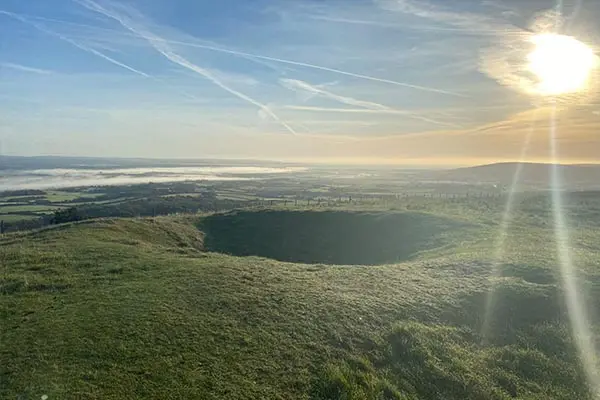
The term ‘ley’ was popularised by Alfred Watkins in the 1920s to describe straight alignments connecting mounds, long-barrows, standing stones, wells, churches, crossroads and hill forts.
Leys can be perceived as overground lines of cosmic consciousness, while underground water lines are more attuned with the Earth.


Telluric Currents
Telluric currents are fluctuating electric currents flowing through the earth and sea, influenced by changes in the Earth’s magnetic field caused by solar activity.
Many traditions associate leys with a telluric ‘current’ — and some leys show twin currents weaving around a central axis (a caduceus pattern).
Working with Lines
Just like underground streams, leys can become disturbed and may benefit from periodic maintenance.
We assess the broader landscape context, map influences on your site, and recommend practical, respectful interventions and placements.
Any work is proportionate, reversible, and shaped by the practical realities of the site.
Who it’s for
For South East clients drawn to sacred landscape, alignments, and the deep ‘feel’ of place — particularly when designing, restoring or re-imagining outdoor spaces.
Frequently asked questions
Here are some common questions about Ley Lines
Ley lines are not proven in a scientific sense. They arise from historical observation, landscape patterning and long-standing cultural traditions. Many people experience consistent effects when working with them, but they are best understood as a way of reading place rather than a fixed physical structure.
Some people report that certain alignments or crossings coincide with areas of disturbance or heightened activity in a site. In practice, work focuses on observing patterns, listening to how a place responds, and making gentle adjustments where appropriate.
Yes. Where a site feels unsettled, simple and respectful interventions — such as repositioning features, working with materials, or adjusting orientation — can help restore balance. The aim is always to support the land rather than impose changes.
Not necessarily. In many cases, small refinements are enough. Where larger changes are suggested, these are discussed carefully and integrated with practical design considerations so the space remains functional as well as harmonious.
Talk to me about your site
If you’re in the South East and would like a grounded conversation about your land and what it needs, get in touch.